
Views: 0 Author: Site Editor Publish Time: 2026-08-03 Origin: Site


Panel builders and electrical engineers constantly face a strict balancing act. You must ensure flawless connection reliability while optimizing cabinet space. You also have to carefully manage your installation labor time. Control cabinet failures often begin right at the termination point. A faulty connection risks halting entire production lines instantly. These electrical failures cause major safety hazards and incredibly expensive downtime. You must select components built to handle severe industrial rigors. This article evaluates the real-world performance of the screw terminal block in modern automation. We will objectively assess mechanical retention, implementation risks, and long-term viability. You will learn how these traditional connections compare against newer alternatives. This ensures you can make the best engineering choice for your specific control panels.
Many control cabinet failures stem directly from poor termination practices. Loose wires cause electrical arcing, localized overheating, and eventual system shutdowns. Selecting the right control panel wire terminal directly impacts your overall system uptime. It also heavily influences post-installation warranty claims. You want to avoid sending technicians across the country to tighten a single loose wire.
We must define what makes a terminal block strategy truly successful. First, it requires fault-free commissioning during the initial startup phase. Second, it must maintain strict, verifiable compliance with global standards like UL and IEC. Finally, it needs excellent adaptability to unforeseen field modifications. You can never predict exactly what your end-users will need to change.
Automated wiring and push-in connectors are certainly trending in the automation industry. However, screw terminals firmly remain the universal baseline for electrical connections. Field electricians possess deep familiarity with them globally. They also offer unmatched ruggedness in punishing industrial environments. You can rely on them when facing highly unpredictable field conditions.
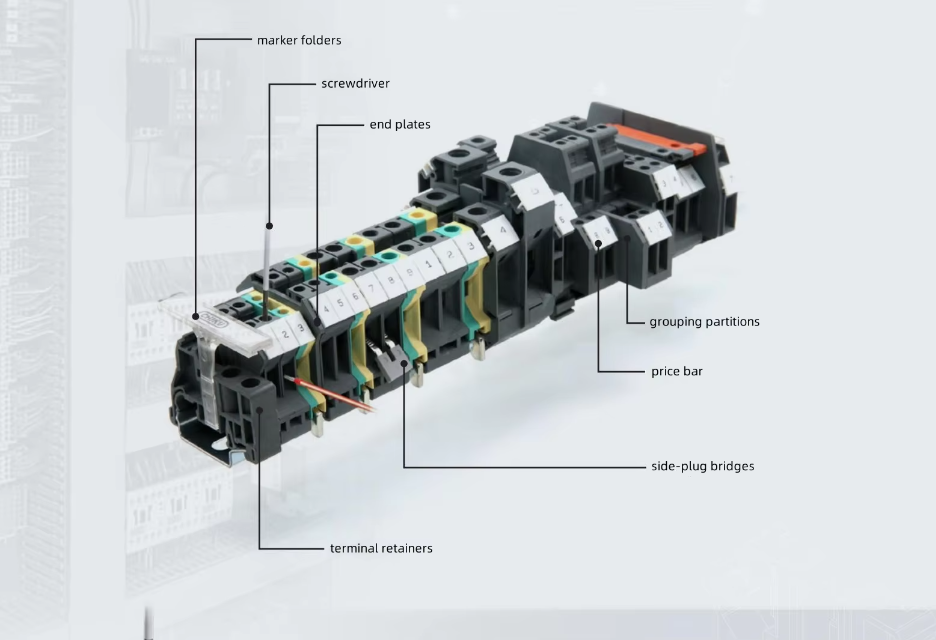
Vibration resistance is absolutely paramount for industrial control panels. Heavy machinery generates constant, high-frequency mechanical stress. Motors, pumps, and compressors send relentless vibrations through the cabinet chassis. A standardized screw clamp mechanism performs exceptionally well here. We can observe the physics of a well-torqued locking mechanism in action. Many premium manufacturers utilize a design similar to the Reakdyn principle.
You insert the wire and tighten the screw down. The clamping collar rises and presses the wire against the current bar. As torque increases, the tension sleeve deforms slightly. This elastic deformation creates a powerful active locking force. It grips the screw threads tightly. This elastic reserve prevents the screw from backing out. The connection remains highly secure despite intense environmental shaking.
Thermal cycling presents another distinct environmental challenge. Electrical panels experience severe temperature fluctuations daily. Components expand during high-load heating phases. They contract when the load drops and the cabinet cools. This natural expansion and contraction creates a dangerous physical cycle. It risks loosening the connection incrementally over time. Engineers refer to this gradual loosening phenomenon as creep.
You face serious electrical hazards if connections creep too far. The contact resistance increases dramatically across the loose joint. This generates even more heat under load. It eventually leads to thermal runaway or electrical fires. You must implement routine maintenance checks. Technicians should verify torque levels periodically. Proper maintenance mitigates the risks of thermal cycling completely.
Current carrying capacity often dictates your initial component selection. We call this metric ampacity. Engineers heavily prefer screw terminals for high-current power applications. They provide a massive advantage in contact surface area. Spring-tension designs pinch the wire tightly at very specific points. A screw clamp operates entirely differently.
It flattens the copper strands against a large, flat conductive bar. This creates a maximized contact surface area. Large surface areas reduce electrical resistance significantly. Lower resistance directly translates to lower heat generation inside the cabinet. You can push higher amperages through the block safely. This makes them ideal for primary power distribution feeds.
Installation speed is a critical metric for busy panel builders. Push-in terminals hold a very clear advantage here. They excel in high-volume, repetitive wiring tasks. You simply push the solid wire directly into the insertion hole. The spring clamps it instantly without tools. This speed validates the massive shift toward automated panel building. Facilities can pump out identical panels much faster. However, you must look at the entire assembly process.
Wire preparation tells a distinctly different story. Push-in technologies demand strict, time-consuming preparation protocols. You cannot easily push bare stranded wire into them. You must strip the insulation precisely. Then you must apply a specific ferrule over the strands. Finally, you crimp the ferrule using specialized hand tools. This adds significant time and material to each individual wire.
Contrast this strict requirement with a traditional screw clamp terminal block. You gain incredible flexibility here. You can terminate bare wires directly into the cage. It easily handles multi-stranded cables without requiring ferrules. You simply strip the wire, insert it, and torque it down. This saves vast amounts of preparation time.
Field servicing scenarios expose more practical differences. We constantly monitor real-world feedback from electrical engineers. Electrician forums frequently echo the exact same sentiments. Screw terminals offer significantly easier field modifications. Technicians carry standard flathead screwdrivers everywhere they go. They can modify a screw connection instantly.
Push-in releases can sometimes be finicky in tight spaces. Some brands require specialized actuation tools to release the internal spring. You might drop this tool in a dark cabinet during an emergency. A standard screw design eliminates this frustrating servicing hurdle completely.
Technical Comparison: Screw Clamp vs. Push-In Technologies
| Feature | Screw Clamp Technology | Push-In Technology |
|---|---|---|
| Installation Speed | Moderate; requires manual torquing per wire. | Extremely fast; tool-free insertion. |
| Wire Preparation | Flexible; accepts bare stranded wire easily. | Strict; heavily relies on ferruled wires. |
| Field Servicing | Simple; uses universal flathead screwdrivers. | Variable; often requires specific actuation tools. |
| Retention Force | Extremely high when torqued to specification. | High, but limited by spring tension ratings. |
Cabinet density poses a constant challenge for layout designers. Real estate inside an industrial enclosure is highly valuable. Smaller cabinets save money and fit into much tighter factory spaces. You must evaluate the physical footprint of your electrical connections. Multi-level configurations provide an excellent spatial solution.
You can easily deploy double-tier or triple-tier block options. A multi-level DIN rail terminal block changes the layout geometry entirely. It stacks the wiring points vertically on the mounting rail. You save critical horizontal space along the back panel. This allows you to pack significantly more I/O into smaller enclosures.
Modularity and bridging facilitate clean, efficient power distribution. You often need to distribute one incoming power feed to multiple sensors. Screw terminals handle these cross-connections very reliably. You install physical metal jumpers or bridges directly between the blocks. However, you must recognize potential scaling constraints here.
Fastening multiple screw bridges takes considerable labor time. Modern plug-in bridging systems snap into place almost instantly. You should carefully weigh the ruggedness of screw bridges against installation speed. Sometimes, the raw durability of a screwed bridge wins out.
Labeling and organization separate amateur panels from professional builds. Complex control cabinets contain hundreds of visually identical wires. Troubleshooting becomes nearly impossible without clear marker integration. You must prioritize clear, highly durable labeling systems.
High-quality blocks feature deep, standardized marker grooves. They securely hold plastic tags printed by automated thermal plotters. Clear organization drastically reduces emergency troubleshooting time. It guides technicians directly to the faulted circuit without guesswork.
We must openly address the most common implementation failures. The over-torque and under-torque risk heavily dominates this list. Improper torque causes the vast majority of termination faults. Under-tightening leaves the wire loose inside the metal cage. This creates dangerous air gaps and high electrical resistance.
Over-tightening creates an equally dangerous physical scenario. It crushes the delicate copper strands outright. It strips the fine screw threads and compromises the locking mechanism completely. A broken wire inside a cabinet is extremely difficult to diagnose.
You must implement aggressive, uncompromising mitigation strategies. We strongly recommend mandating the use of calibrated torque screwdrivers. Do not rely on a technician's physical "feel." Establish mandatory quality assurance checks during panel assembly. Inspectors should verify torque marks on a random sample basis.
Regulatory compliance ensures global market acceptance and baseline safety. Your chosen components must pass rigorous testing protocols. Screw terminals routinely meet stringent UL 1059 industry standards. They also comply fully with IEC 60947-7-1 global requirements.
UL testing involves aggressive mechanical pull-out force evaluations. It includes extreme temperature rise testing under continuous heavy loads. Choosing compliant components protects your manufacturing company from massive liabilities.
Corrosion silently destroys connections in harsh operating environments. Coastal facilities and chemical processing plants present severe atmospheric challenges. You must carefully specify the correct housing and contact materials. Briefly touch upon the absolute necessity of copper alloy bodies.
They must feature high-quality tin or nickel plating on the contacts. Plating creates a critical barrier against rapid oxidation. It prevents galvanic corrosion when you terminate different metal types. This ensures your control panel survives for decades in unforgiving conditions.
You need a clear, objective decision framework for your next project. It is crucial to evaluate your specific engineering parameters.
Choose Screw Terminals If:
Re-evaluate If:
Next-Step Actions:
The screw terminal block is certainly not an obsolete technology. It remains a highly specialized tool for heavily demanding scenarios. You rely on it for massive retention force and broad wire compatibility. It handles heavy gauges and bare strands effortlessly.
Successful performance relies entirely on implementing proper installation protocols. You must maintain strict torque control at all times during assembly. Appropriate environmental matching ensures decades of safe, continuous operation. Select them wisely, install them correctly, and they will rarely fail you.
A: Yes, they often do. Industry best practices acknowledge the realities of thermal cycling. Metals expand and contract as current loads change. This natural movement can cause connections to loosen over time. Experts highly recommend establishing a routine maintenance schedule. Technicians should periodically check and verify torque values. This differs greatly from spring-loaded terminals, which are generally considered maintenance-free.
A: We generally advise against this practice. You must carefully verify UL compliance regarding multiple wires in a single clamp. Mixing solid and stranded wires often causes unequal clamping force. The solid wire prevents the clamp from securing the stranded wire properly. You should use specific dual-wire rated blocks if necessary. Alternatively, you can crimp both wires into a single twin ferrule.
A: They impact it significantly. You must understand the difference between UL recognized (UR) and UL listed components. Using properly rated terminal blocks ensures overall compliance. It directly affects the Short Circuit Current Rating (SCCR) for the entire cabinet. If you use unrated blocks, inspectors will fail the entire panel. Always verify the individual component ratings before finalizing your cabinet design.


