
Views: 0 Author: Site Editor Publish Time: 2026-08-03 Origin: Site


The industrial shift from traditional screw connections to spring-loaded mechanisms continues to gain incredible momentum across the manufacturing sector. Panel builders increasingly favor these modern alternatives to capture significant labor savings and achieve superior vibration resistance. However, compatibility between conductor types and connection mechanisms remains a primary engineering concern on the shop floor.
Not all wire types behave the same under constant spring tension inside the control panel. Inserting the wrong wire type or improperly prepping the conductor quickly leads to high contact resistance. This misalignment causes thermal failure, localized melting, or dangerous wire pull-out under stress. Simply put, ignoring wire mechanics ruins otherwise excellent panel designs.
This guide breaks down the technical compatibility between common wire types and spring connection technologies. We help panel builders, electricians, and design engineers standardize their specifications for better safety. You will learn exactly how to match your conductors to the right terminal block architecture to optimize both installation speed and long-term performance.
To build reliable control panels, you must understand how active connection mechanisms grip conductive materials over time.
Traditional screw terminals rely on static torque. You tighten a screw down onto the copper core, and it stays perfectly rigid. However, a spring terminal block operates entirely differently. It applies dynamic, continuous pressure against the inserted conductor. Copper naturally expands as ambient panel temperatures rise. It then contracts as systems cool down. The internal spring mechanism breathes alongside the wire. It constantly adapts to these thermal shifts to maintain uninterrupted electrical contact.
Insertion force acts directly upon the very tip of the wire. When you push a conductor into a terminal, you rely on the physical structure of the metal to push past the internal spring leg. If a conductor lacks structural rigidity, its individual copper strands fold back upon themselves. They splay outside the designated contact zone. This creates a dangerously weak electrical path. It also poses a severe short-circuit risk if stray strands touch adjacent metal components.
Engineers consistently face tight space constraints and severe vibration inside modern enclosures. You see this heavily in motor controls, railway electronics, and heavy machinery automation. A standard DIN rail terminal block assembly often dictates connection choices based precisely on these harsh realities. Choosing the proper conductor mechanics directly prevents system failure in these highly demanding industrial environments.
Solid wire boasts excellent structural integrity from end to end. Its high longitudinal column strength allows direct, tool-free insertion into most modern push-in blocks. The stiff copper core simply pushes the spring open as you insert it.
This wire type provides a highly predictable, singular point of contact against both the internal copper busbar and the clamping spring. Because the metal remains uniform, you achieve excellent conductivity and minimal electrical resistance. However, it severely lacks mechanical flexibility. You should actively avoid using solid wire in highly dynamic applications. If the cable continuously moves or bends outside the panel, solid copper eventually fatigues. It will snap under prolonged mechanical stress.
Bare stranded wire offers unmatched flexibility. Panel builders absolutely love it for routing easily inside tight cabinet spaces. It absorbs external mechanical shock beautifully without fracturing or breaking.
However, you face a harsh reality during the actual insertion process. You cannot push bare stranded wire directly into most spring designs. The individual strands immediately splay apart under the insertion pressure. You must manually open the internal spring using a specialized slotted screwdriver prior to insertion. Once you correctly seat the wire and remove the tool, the spring snaps shut. It flattens the strand bundle against the current bar. This action creates a secure, high-surface-area electrical connection.
We consider ferruled fine-stranded wire the ultimate hybrid wiring solution for industrial control panels.
Crimping a rigid metal ferrule over a fine-stranded copper tip provides the exact rigid insertion profile you get from solid wire. It essentially creates a solid tip on a highly flexible cable. Furthermore, a high-quality crimp forms a permanent gas-tight connection. This effectively prevents the long-term oxidation of individual fine strands. It allows flexible fine-stranded wire to slide seamlessly into a push in wire terminal. You do not need any manual actuation tools. This efficiency dramatically reduces overall wiring time during complex panel assembly.
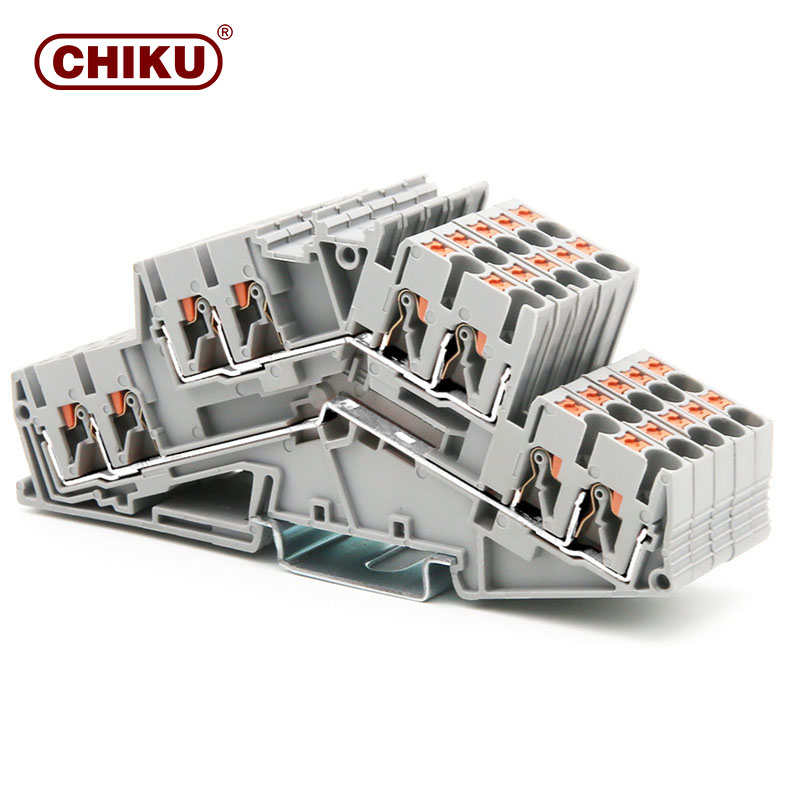
Manufacturers design different spring mechanisms to accommodate specific wire preparation habits. You must match the internal spring architecture to your chosen conductor style.
Push-in connections feature a specialized, angled leg spring. You need highly rigid conductors to overcome this heavy spring force during direct insertion. Solid wire or ferruled stranded wire works perfectly here. Push-in mechanisms maximize your installation speed on the factory floor because electricians do not need to pick up a hand tool. You simply strip the wire, crimp a ferrule, and push it directly into the port.
Standard variants use an active tension-clamp cage design. You must use a screwdriver to force open the clamp chamber before inserting any wire type. Once you remove the screwdriver, the entire cage snaps shut onto the inserted conductor, trapping it securely.
Choose a spring clamp terminal block if your project strictly mandates using bare stranded wire. This cage design safely houses loose strands without damaging them. Choose push-in alternatives if you plan to standardize your assembly line entirely around crimped ferrules or solid copper conductors.
Beyond simple ease of use, engineers must verify electrical and mechanical performance against strict international safety standards.
Spring connections rigorously meet both IEC and UL standards for conductor pull-out force. They perform exceptionally well across dozens of different wire gauges. The dynamic steel spring actively bites into the softer copper wire. Unlike rigid screw terminals, constant machine vibration actually embeds the wire deeper into the contact zone. The movement continuously self-adjusts the connection rather than shaking it loose.
Copper wires experience a phenomenon known as "creep" or cold flow over time. Heavy electrical loads generate heat, making the metal expand slightly. Cooling cycles make it contract. Over years of operation, this thermal cycling eventually loosens rigid screw clamps. Spring tension entirely mitigates this insidious issue. The spring actively expands and contracts precisely alongside the copper wire. It guarantees continuous clamping force and prevents sudden loose connections.
Analyzing voltage drop metrics shows excellent overall conductivity across modern terminal designs. Using properly ferruled wire in spring terminals provides optimal, lowest-possible contact resistance. Bare stranded wire also performs exceptionally well electrically, but it requires highly precise seating during installation.
Performance Comparison Chart
| Connection Type | Vibration Resistance | Insertion Speed | Thermal Cycle Reliability |
|---|---|---|---|
| Traditional Screw Terminal | Low (Prone to shaking loose) | Slow (Requires precise torquing) | Moderate (Suffers from copper cold flow) |
| Standard Spring-Cage | High (Dynamic active tension) | Medium (Screwdriver tool required) | Excellent (Adapts to thermal expansion) |
| Push-In Spring Terminal | High (Dynamic active tension) | Fast (Completely tool-free insertion) | Excellent (Adapts to thermal expansion) |
Even the finest engineering strategy fails if shop floor execution falls short. Panel builders face several distinct realities when installing these components.
Strip length matters immensely when dealing with spring tension. Over-stripping the plastic jacket exposes bare, live wire outside the insulated housing. This immediately creates a deadly arc flash hazard inside crowded panels. Conversely, under-stripping forces the internal metal spring to clamp down directly onto the plastic insulation instead of the copper core. Spring terminals possess absolute zero tolerance for incorrect strip lengths. You must strictly follow the manufacturer's precise stripping guide printed on the block.
Tooling defines the final connection shape. You generally choose between hexagonal, square, and trapezoidal crimp dies. Square crimps usually provide a much better geometric fit for the rectangular entry profiles found in most spring terminals. They slide in smoothly and maximize flat surface contact against the internal busbar.
We routinely see technicians using the wrong size screwdriver. Jamming a massive flathead driver into a tiny actuation slot severely damages the delicate plastic housing. Worse, twisting the wrong tool can permanently bend or break the internal spring mechanism. This destroys the block's holding force entirely. Always use the exact slotted driver size specified by the terminal manufacturer.
Use a highly structured approach when specifying your final panel components. Haphazard selection leads to inconsistent wiring quality.
Calculate the direct time savings on your assembly floor. Compare the incredibly fast insertion of push-in blocks using ferruled wire against standard spring clamps using bare wire. High-volume panel builders regularly achieve massive labor efficiency by adopting the ferrule and push-in combination. The time saved clipping wires straight into the blocks offsets the time spent crimping the ferrules.
Consider the final physical destination of your control panel. You should definitively specify spring terminals if the cabinet ships across long distances via rail or sea freight. Constant transit vibration easily loosens standard panel screws before the machine ever powers on. Similarly, heavy industrial environments like stamping presses demand the constant pressure of active spring connections.
Before launching full-scale procurement, we recommend taking a few practical validation steps on your own shop floor.
The perfect electrical connection relies heavily on matching physical conductor traits to the right internal terminal design. Solid and properly ferruled conductors pair perfectly with modern push-in technology. They maximize assembly speed and eliminate tooling needs. Conversely, bare stranded wire remains a highly viable, flexible choice when you pair it correctly with standard spring-cage blocks.
Your final engineering choice heavily dictates the speed, safety, and long-term reliability of your entire control panel. We strongly recommend aligning your physical wire preparation procedures with your chosen terminal block architecture. Audit your wire strippers and crimping dies today before initiating any full-scale component procurement. Clear procedural alignment prevents frustrating assembly bottlenecks and ensures a flawless, vibration-proof installation for your end users.
A: Generally no, unless the specific terminal block features a dedicated actuation button to open the spring first. Pushing bare stranded wire directly against a strong push-in spring causes the fine strands to splay apart. This leads to broken strands, highly compromised electrical contact, and potential short circuits outside the plastic housing.
A: No, standard spring-cage blocks safely and securely accept bare stranded wire. You simply open the cage with a slotted tool, insert the bare wire bundle, and remove the tool. The clamp safely flattens the bundle. However, ferrules remain highly recommended for push-in variants and to prevent accidental strand breakage during maintenance.
A: Yes, modern spring terminals easily handle high amperage ratings. They consistently outperform traditional screw terminals during high-current thermal cycling tests. The dynamic internal spring maintains constant active contact pressure as the copper wire heats up and expands. This completely prevents the dangerous loose connections that plague static screw terminals over time.


