
Views: 0 Author: Site Editor Publish Time: 2026-08-03 Origin: Site


Industrial automation relies on high-density control panels to keep operations running smoothly. In these environments, wiring efficiency and connection reliability directly impact bottom-line project costs and system uptime. You need infrastructure built for continuous, uninterrupted manufacturing.
Traditional screw connections present serious scalability bottlenecks during panel assembly. They require manual torque application and significantly increase overall installation time. Furthermore, they remain highly vulnerable to loosening from mechanical vibration on the factory floor. These outdated methods slow down production schedules and introduce critical failure risks into your systems.
Upgrading to push-in connection technology shifts panel building from a labor-intensive mechanical process to a streamlined, standardized operation. This upgrade offers measurable reductions in commissioning time and long-term maintenance overhead. You will learn the mechanical differences, core evaluation drivers, and implementation strategies necessary to optimize your next automation project.
Panel wiring remains a highly manual task across the manufacturing industry. As production demands grow, engineering teams face real business constraints. Scaling production requires faster assembly without sacrificing electrical integrity.
Traditional screw terminals require experienced, skilled labor. Technicians must apply the exact proper torque to every single connection point. Overtightening damages the fragile copper threads inside the terminal. Undertightening leaves loose connections behind. Training new staff to achieve perfect torque takes considerable time. Skilled labor shortages make this manual process incredibly costly and inefficient. You simply cannot scale panel production when every wire requires meticulous hand-tightening.
Heavy machinery generates continuous micro-vibrations across the facility. These subtle movements loosen standard screw connections gradually over time. Loose wires inevitably lead to dangerous thermal events. They also cause intermittent signal drops across communication networks. Automation processes halt completely when these electrical failures occur. Fixing them requires extensive troubleshooting and expensive downtime. You need a connection method immune to these environmental vibrations.
Automation architectures continue growing more complex every year. Engineers must integrate more I/O modules into existing panel footprints. You need ultra-compact wiring solutions to meet this increasing demand. Bulky screw terminals waste valuable real estate inside the cabinet. They limit your ability to scale components within restricted enclosures. Expanding panel size often requires redesigning the entire machine footprint. This leads to unwanted engineering delays and higher material costs.
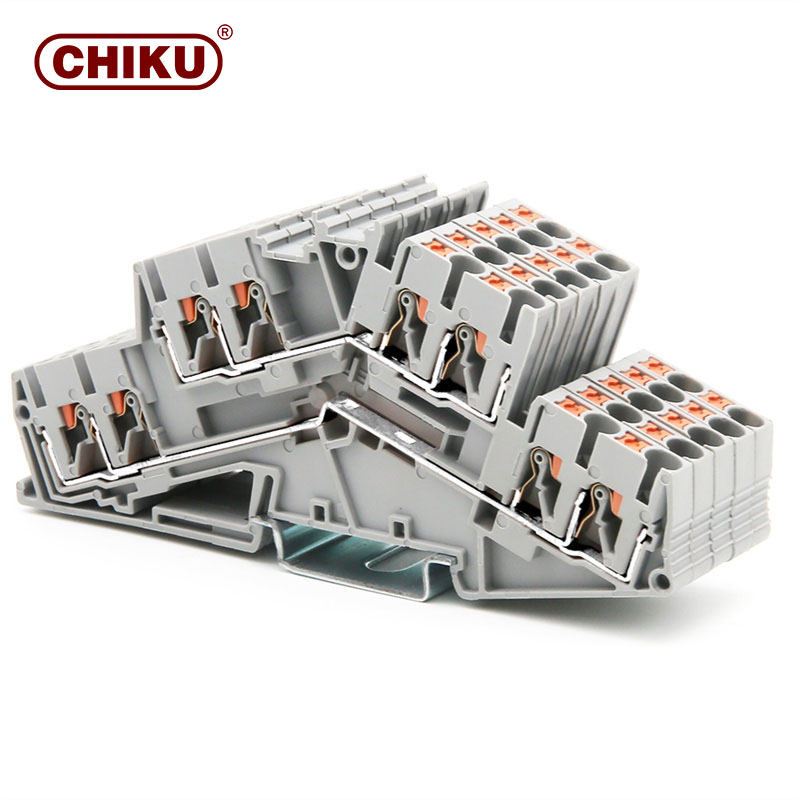
Engineers often confuse different spring-based connection methods. We must clarify how these internal mechanisms operate. Understanding the physics helps you choose the right component.
A standard spring clamp terminal block requires two hands for operation. The operator uses a screwdriver to pry open the internal cage spring. They insert the wire into the open slot. Tension applies firmly onto the wire once they remove the tool. This method works very well for vibration resistance. However, it takes extra effort and time. The constant need for a tool slows down mass wiring tasks.
A push in terminal block features a highly specialized internal leg spring. You can push solid wires directly into the terminal body. Stranded wires also insert easily if they have ferrules attached. You do not need any tools for this insertion. The natural insertion force automatically pushes the spring open. The spring then clamps down instantly against the copper. It provides maximum retention force and an airtight electrical connection.
Both technologies offer excellent vibration resistance and eliminate torque requirements. However, the push in wire terminal drastically reduces the required physical insertion force. It completely eliminates the two-handed operation required by older spring designs. You save massive amounts of time and reduce technician hand fatigue. This makes it the superior choice for high-volume control panel assembly.
| Feature | Legacy Screw Terminal | Standard Spring Clamp | Push-In Technology |
|---|---|---|---|
| Tool Required for Insertion | Yes (Screwdriver) | Yes (Screwdriver) | No (for solid/ferruled wires) |
| Operation Style | Two-handed | Two-handed | One-handed |
| Vibration Resistance | Low (Requires retightening) | High | Very High |
| Wiring Speed | Slow | Moderate | Fast (Up to 50% faster) |
| Maintenance Frequency | High (Routine torque checks) | Zero maintenance | Zero maintenance |
System integrators actively choose this specific technology for measurable performance gains. Upgrading the connection method solves multiple engineering challenges simultaneously.
Tool-free installation allows for rapid, one-handed panel wiring. Technicians work significantly faster when they skip tool handling. This speed cuts overall panel building time drastically. It also eliminates a major quality assurance step entirely. You no longer need to verify torque specifications across the board. Thousands of connection points per cabinet become hassle-free. Your team can finish projects earlier and move on to the next build.
A dynamic spring design brings huge reliability benefits to your facility. The spring dynamically adjusts to any slight wire deformation. This continuous adjustment maintains constant contact pressure across the joint. These connections easily surpass stringent railway and marine certification standards. They meet the strict IEC 61373 standard for shock and vibration resilience. You get better uptime in harsh, physically demanding manufacturing environments.
A front-entry wiring design simplifies your layout planning. It allows for tighter cable routing between plastic wiring ducts. You can fit more wire connections into much smaller spaces. This design enables higher density configurations for any standard DIN rail terminal block layout. Ultimately, you shrink your overall enclosure requirements. Smaller enclosures save money and fit better on crowded factory floors.
Every new technology introduces specific challenges and workflow changes. You must understand these engineering realities before committing to an upgrade.
To realize the true "tool-free" benefit, you must prepare wires correctly. Technicians must crimp stranded wires using dedicated metal ferrules. This specific step requires specialized crimping hand tools or automated stripping machines. Integrators must factor ferrule costs and crimping equipment into their upfront project budgets. You need to account for these initial material expenditures early. Proper preparation guarantees the fastest possible insertion times later.
Bare stranded wire presents a very specific physical challenge. You cannot push it directly into the terminal without a ferrule. The flexible strands will simply bend or "birdcage" under insertion pressure. Instead, bare wire requires actuating the internal pusher button using a small tool. This workaround makes the block function exactly like a standard spring clamp. It defeats the speed advantage. Therefore, standardizing on ferrules becomes a strict requirement for maximum efficiency.
Push-in terminals typically carry a higher per-unit price. They cost slightly more than legacy screw terminals at the time of purchase. The financial return is realized strictly in massive labor savings. You also save heavily on reduced routine maintenance intervals. You must model these operational savings accurately during the planning phase. Most teams find the initial investment pays off during the very first panel build.
Not all push-in systems perform equally on the market. Use these technical criteria to evaluate potential suppliers carefully.
Evaluate the internal release mechanism closely. Look for color-coded push buttons versus simple slotted tool holes. Integrated buttons improve safety and ease of maintenance drastically. Operators clearly see where to press to release the wire. Buttons also prevent technicians from jamming the wrong sized screwdriver into the mechanism. This protects the internal spring from accidental physical damage.
Assess the availability of compatible system accessories. You will definitely need plug-in jumpers to distribute power across adjacent blocks. Testing adapters also help engineers troubleshoot signals without removing wires. Standardized marking systems ensure seamless integration and clear panel identification. A robust accessory ecosystem speeds up both assembly and future troubleshooting efforts.
Verify necessary industry certifications before making a final purchase. Check for UL, CSA, and IEC global approvals. Ensure you have ATEX or IECEx ratings if building for hazardous locations. Match these certifications directly to your final deployment environment. Global compliance guarantees the components will pass local site inspections safely.
Confirm the mechanical spring tension limits. It must be officially rated for your specific electrical load requirements. This becomes critical in high-current power distribution applications. Undersized springs will generate heat under heavy electrical loads. Always verify the manufacturer's derating curves based on ambient cabinet temperatures.
Push-in terminal blocks represent much more than a simple convenience feature. They serve as a highly strategic choice for high-volume panel builders. Automation facilities prioritizing uptime, space efficiency, and labor reduction benefit greatly from this technology. The elimination of torque checking alone justifies the transition for most engineering teams. You secure a safer, more reliable electrical connection that resists industrial vibration completely.
As a next step, we strongly recommend auditing your current assembly processes. Review your recent panel wiring times and historical maintenance logs. Calculate your potential labor savings. Next, try testing a pilot batch of push-in terminals. Apply them to a non-critical control sub-assembly first. Evaluate the speed and quality results before initiating a full factory rollout.
A: No, but they are highly recommended. Solid wires can be pushed in directly. Bare stranded wires require a tool to open the spring. Ferrules allow stranded wires to be pushed in without tools.
A: Yes. Modern push-in technology is engineered to handle high currents. They often support up to 125A or more, depending on the manufacturer and wire gauge. They provide highly secure, low-resistance connections.
A: You remove it by pressing an integrated actuation button. Alternatively, you can insert a standard screwdriver into the designated release slot. This safely opens the spring and allows you to extract the wire.
A: Yes, they are designed to snap onto standard 35mm (NS 35) DIN rails. This ensures easy drop-in replacement capability for older terminal block systems inside existing enclosures.


